
The CREC has held the final presentation event for the Intercluster project “Social Licence in Ecological Transition Projects”, an initiative developed jointly with the Bioenergy Cluster of Catalonia and the Catalonia Energy Efficiency Cluster, with the collaboration of ARC Mediació Ambiental.
The event, held at the Auditorium of the Administrative District of the Government of Catalonia, brought together representatives from public administration, companies, and organisations to reflect on the importance of social licence in promoting projects related to the ecological transition.
The event began with an institutional round table focused on the role of social licence in the implementation of public policies. Participants included Rosa Altisent, Director General of Agriculture and Livestock; Anna Camp, Director of the Catalan Energy Institute (ICAEN); and Albert Planell, Director of the Catalan Waste Agency, who shared their perspectives on the main challenges facing the ecological transition and the need to incorporate citizen participation, dialogue, and trust as essential elements to ensure the success of projects.
From the CREC, we would like to express our special thanks for the collaboration of the Catalan Waste Agency in this project, as well as for the participation of its director, Albert Planell.
One of the key moments of the event was the presentation of the Guide for the Management of Social Licence, developed with the technical support of ARC Mediació Ambiental. During the session, the ARC team explained the process behind the creation of the guide, based on case analysis, the experience of the participating clusters, and the identification of best practices in social licence management. They also presented its structure and different applications, highlighting that it is a flexible tool designed to support organisations according to the stage of development of each project. The guide provides specific recommendations both for the initial planning phases and throughout project implementation, as well as for situations where dialogue and relationships with different stakeholder groups need to be strengthened.
Beyond the presentation of the guide, the event conveyed a shared message: social licence is not an objective achieved at a specific point in time, but rather a process that is built and renewed every day through transparency, active listening, and consistency between what is communicated and what is done.
In this regard, the President of the Catalonia Waste Cluster, Elisabet Alier, highlighted that: “Trust is built through actions. Social licence is renewed every day through the way we work. This guide does not eliminate difficulties, but it helps us anticipate them and move from a reactive approach to a preventive one, based on dialogue.”
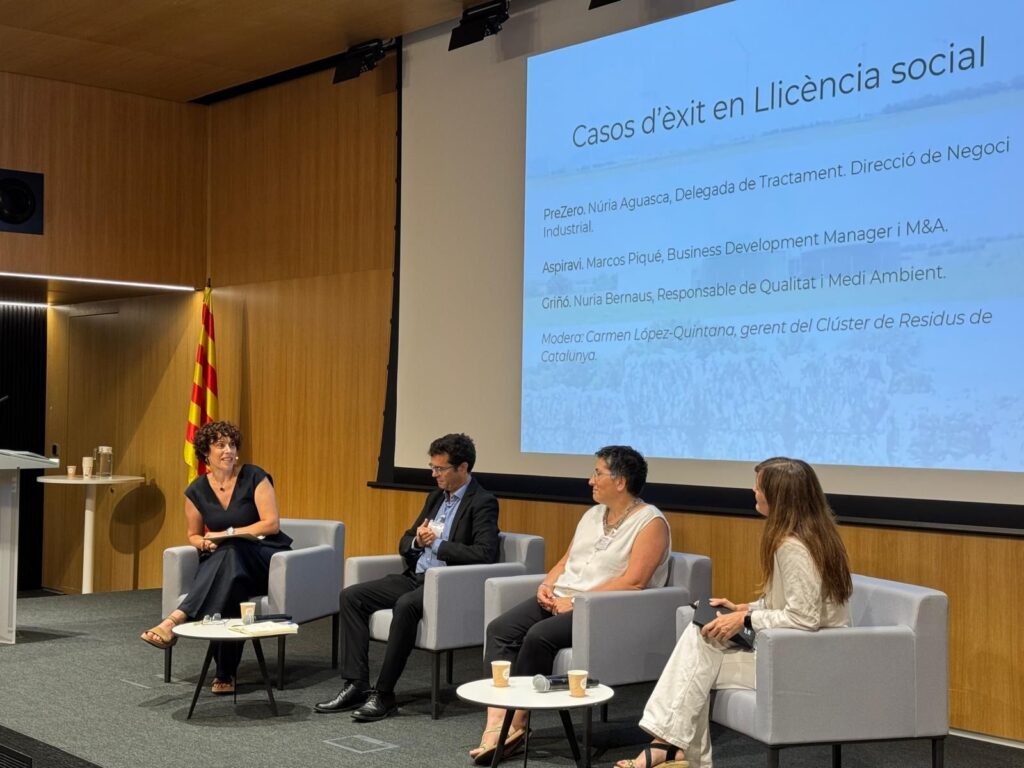
The second round table focused on several successful cases from organisations that have incorporated social licence into their projects. Representatives from PreZero, Aspiravi, and Bioenergia d’Almenar shared their experiences and the lessons learned from developing projects linked to the ecological transition. The examples presented showed that having a presence in the territory, actively listening to communities, providing information and education, and maintaining transparent and continuous communication are key factors in building trust and encouraging project acceptance. Participants also agreed on the importance of establishing stable relationships with local stakeholders from the earliest stages of each initiative.
The event concluded with an institutional closing session led by Joan Romero, Executive Director of ACCIÓ, whom we would like to thank for his attendance and for his closing remarks and encouragement. In his speech, he highlighted the value of collaboration between clusters as a tool to address shared challenges and promote initiatives that contribute to a more innovative, competitive, and territory-connected ecological transition.
From the CREC, we would like to thank all the companies, institutions, and professionals who participated in this project and made this initiative possible. Collaboration between clusters once again demonstrates that sharing knowledge, experiences, and tools is essential to moving towards an ecological transition that is more participatory, more robust, and with greater social involvement.
