
The waste management sector is undergoing a profound transformation. New regulatory frameworks, the evolution of collection systems, the incorporation of new technologies and the transition towards a more circular economy are creating increasingly complex challenges. In this context, having professionals with specialised knowledge and the ability to respond to the sector’s emerging needs is more important than ever.
This is one of the areas of work of CREC, whose objectives include contributing to talent development and professional training within the waste management and circular economy sectors. Advancing the transformation of the sector requires more than new solutions or a more demanding regulatory framework: it also requires people capable of applying and adapting these solutions and turning them into results.
New challenges, new professional profiles
For many years, municipal waste management was primarily associated with operational activities: collection, transport and treatment. Today, however, this reality has changed.
European and Spanish legislation sets increasingly ambitious targets for waste prevention, preparation for reuse and recycling. Law 7/2022 on waste and contaminated soils for a circular economy establishes recycling targets of 55%, 60% and 65% for 2025, 2030 and 2035, respectively. At the same time, Directive (EU) 2018/850 sets a limit of 10% for municipal waste sent to landfill from 2035 onwards.
Achieving these targets requires concrete decisions in each territory. And making these decisions effectively involves much more than simply understanding existing collection systems.
Designing and implementing an efficient model involves analysing the characteristics of a territory, interpreting data, defining the most appropriate system, determining resource requirements, assessing economic viability and monitoring performance. It is a technical and multidisciplinary task that requires specialised knowledge and professionals prepared to address these new challenges.
Talent as a driver of transformation
At CREC, we understand that the development of the sector also depends on investing in talent, knowledge and professional training.
As a cluster that connects companies and organisations from different areas of the waste management life cycle, we work to facilitate knowledge exchange, create opportunities for collaboration and contribute to strengthening the professional capabilities required by the sector.
The transition towards more circular models depends not only on technology or regulation. It also depends on the people responsible for designing, managing and implementing these new models.
For this reason, promoting specialised training opportunities and facilitating access to up-to-date knowledge is an important part of continuing to professionalise the sector and preparing it for the challenges of the coming years.
A new specialised training programme
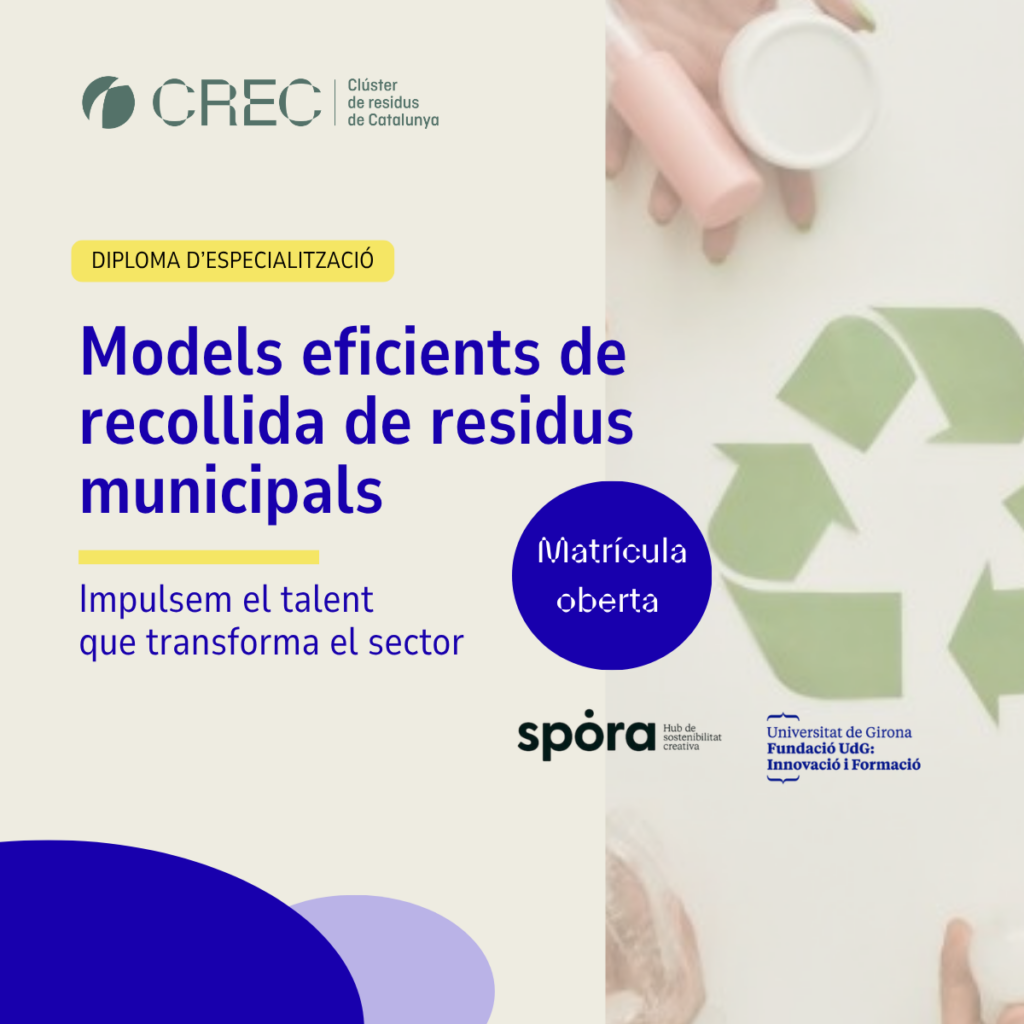
In this context, CREC is giving visibility to the Specialisation Diploma in Efficient Municipal Waste Collection Models, promoted by Spora together with the University of Girona Foundation.
The programme is aimed at professionals from public administrations, companies and consultancies who wish to deepen their knowledge of the design, sizing and monitoring of highly efficient waste collection models.
The launch of this training programme responds to an increasingly evident need within the sector: to develop professional profiles capable of approaching waste management from a technical and strategic perspective, while adapting solutions to the specific characteristics of each territory.
For CREC, initiatives such as this contribute to strengthening one of the essential foundations for moving towards a more prepared, innovative and competitive sector: talent.
