
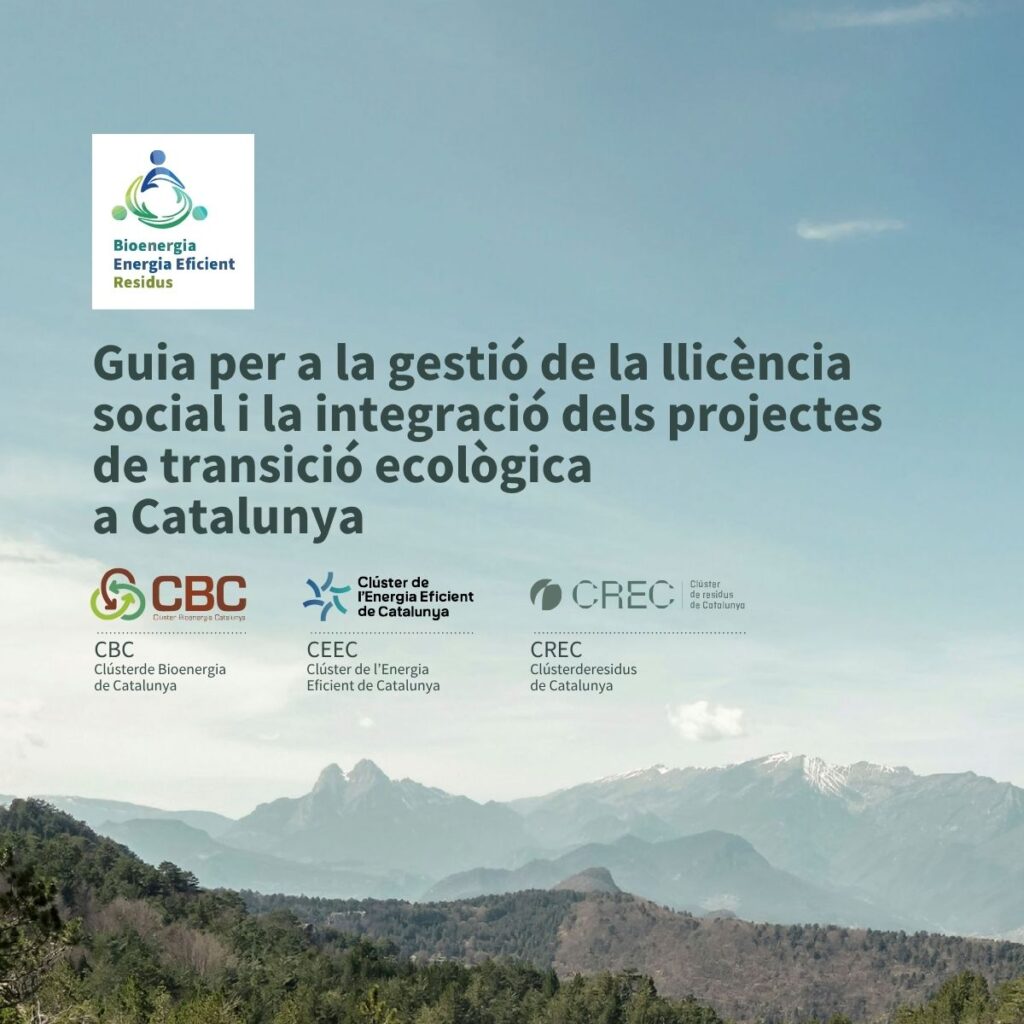
The publication provides practical recommendations for integrating dialogue, transparency and stakeholder participation from the earliest stages of project development. It also showcases real-life experiences from companies that have already embedded social licence into their strategies. Promoted by the three clusters, the initiative aims to contribute to a more participatory, effective and territorially aligned ecological transition.
The ecological transition requires new infrastructure linked to renewable energy, bioenergy and waste management. However, the success of these projects depends not only on their technical or economic viability, but also on their ability to build trust and establish strong relationships with the communities and territories where they are developed.
With this objective, the Bioenergy Cluster of Catalonia (CBC), the Catalonia Efficient Energy Cluster (CEEC) and the Waste Cluster of Catalonia (CREC) jointly developed the project Managing Social Licence and the Territorial Integration of Ecological Transition Projects in Catalonia, an initiative that culminated on 10 July with the presentation of the project’s guide.
A guide to integrating the social dimension into projects
The guide was developed to address one of the main challenges currently facing infrastructure developers: ensuring that projects not only comply with all administrative requirements but are also understood, accepted and successfully integrated into the social and territorial context in which they are implemented.
Rather than viewing social licence simply as a communication tool, the publication proposes a comprehensive approach based on eight key pillars: territorial integration, transparency, participation, governance, local value creation, communication, education and impact management.
In addition, it advocates a preventive strategy by recommending that dialogue with local communities begin even before the project’s administrative approval process starts.
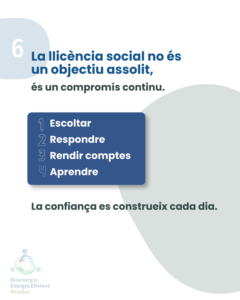
A practical tool for public and private project developers
Designed for both public and private project developers, the guide brings together methodologies, practical recommendations, implementation tools and real-life examples to help organisations incorporate the social dimension as a strategic element in the development of their projects.
The document is the result of a participatory process involving companies, organisations and experts from the three sectors represented by the clusters.
Success stories demonstrating that social licence is achievable
The guide also features real experiences from companies that have made their relationship with local communities a key factor in the success of their projects.
From the bioenergy sector, Genia Bioenergy highlights that trust begins long before a project is fully defined. “It is essential to start the dialogue from the earliest stages, correctly identify local stakeholders, clearly explain how the facility will operate and respond transparently to citizens’ concerns. Social acceptance is strengthened when the community sees that the project listens, responds and acts consistently,” explains Cristina Pascual, Social Licence Manager at Genia Bioenergy.
For its part, PreZero, a leading company in the waste management sector, believes that social licence should be embedded in the company’s day-to-day operations. According to Núria Aguasca, Treatment Delegate within the Industrial Business Division, “Transparency, active listening and education must be integrated into decision-making. Trust is not built overnight; it grows through consistency, responsibility and by demonstrating that listening to citizens genuinely influences the way we work.”
In the renewable energy sector, Aspiravi España emphasises the importance of local presence. According to Marcos Piqué, Renewable Energy Business Development Director, “Having a local presence from the earliest stages of a project, understanding the concerns of local residents and adapting the project to the territory are essential to building social acceptance. Trust is maintained through continuous outreach and by delivering on the commitments made.”
A shared ecological transition
Through this initiative, the three clusters reinforce their commitment to an ecological transition that is not only technically feasible and environmentally necessary, but also socially supported.
The new guide aims to become a reference tool for companies, public authorities and local stakeholders, helping to promote projects capable of generating economic, environmental and social value through dialogue and collaboration.
📥 Download the Guide
Explore the Guide to Managing Social Licence and the Territorial Integration of Ecological Transition Projects in Catalonia and discover practical recommendations, methodologies and success stories to help integrate the social dimension into your projects.
