CREC is promoting a benchmarking trip to France to explore leading practices in waste management, industrial innovation and reuse, while strengthening connections between companies and organisations within Catalonia’s circular economy ecosystem.
How can we move towards a more circular economy by drawing on models already being developed in other European regions? What solutions are being implemented to recover materials, improve waste management and connect innovation with business needs?
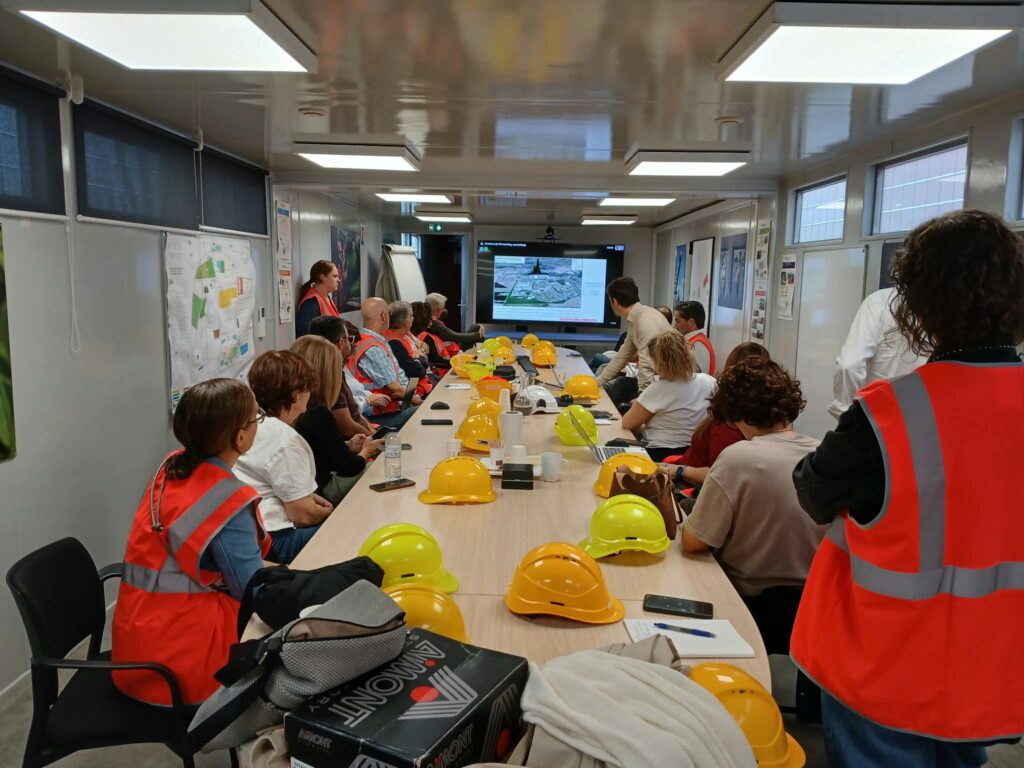
To address these questions, CREC organised a benchmarking trip to France from 28 to 30 September, bringing together companies and organisations from Catalonia’s waste management and circular economy sectors. Over three days, the delegation visited different locations across France to explore industrial facilities, waste management organisations, innovation centres and reuse initiatives, gaining complementary perspectives on the sector’s current challenges.
Supported by ACCIÓ, the initiative combined technical learning with the exchange of experiences and networking, pursuing a dual objective: identifying practices and solutions relevant to Catalan businesses and strengthening collaboration among CREC member organisations.
Exploring Different Models to Address Waste Management Challenges
The first part of the programme focused on understanding how waste management is organised in France, from Extended Producer Responsibility schemes to regional strategies and the infrastructure required to manage material flows.
In Paris, the delegation met with VALOBAT, Citeo and FEDERREC Occitanie to explore how Extended Producer Responsibility (EPR) schemes operate. These schemes play an important role in waste management by making producers responsible for aspects associated with their products throughout their life cycle.
The discussions provided insights into how these systems are organised, the stakeholders involved and the coordination mechanisms that enable them to function. This knowledge is particularly valuable for comparing experiences across different territories and identifying elements that could contribute to improving waste management models.
The delegation also visited the headquarters of the Île-de-France Region, where it met with Choose Paris Region, Métropole du Grand Paris, ORDIF and HAROPA PORT. These meetings broadened the perspective by addressing regional planning, the specific challenges facing major metropolitan areas and strategies linked to the Zero Waste 2030 objective.
One of the key areas of interest was the role of data and territorial knowledge in decision-making, particularly through ORDIF, the regional waste observatory. The delegation also explored the potential of inland waterway transport for waste logistics with HAROPA PORT, highlighting the importance of considering infrastructure and logistics systems as part of circular economy strategies.
This first series of visits placed waste management within a broader context in which regulation, public planning, information and logistics work together to support the transition towards more efficient models.
From Material Recovery to Industrial Innovation
On the second day, the delegation travelled to the Hauts-de-France region to explore initiatives focused on material recovery and the development of innovative industrial solutions.
At Galloo Plastics, in Halluin, participants gained first-hand insight into the operation of an industrial facility dedicated to the recycling of ferrous and non-ferrous metals. The visit provided an opportunity to learn more about shredding, separation and material recovery processes, as well as the complexity of the operations required to transform waste streams into usable resources.
Visiting these facilities in person offers a valuable complement to technical information, helping participants understand the scale of the processes, the operations involved in material recovery and the role of industrial infrastructure in advancing the circular economy.
Innovation was also a central focus at CETI (Centre Européen des Textiles Innovants), where the delegation explored research and development projects involving fibres, polymers, new materials and textile recycling.
In a field where material recovery and value depend largely on the technical possibilities for treatment and transformation, connecting research with industry is essential. The visit to CETI demonstrated how a specialised centre can support the development of solutions, from initial research to the creation of prototypes and industrial applications.
The day concluded with a meeting with Pôle TEAM2, a competitiveness cluster specialising in environmental technologies and the circular economy. Discussions with the organisation and companies within its network helped identify shared interests and explore potential avenues for cooperation, including participation in European projects.
These visits highlighted that developing circular solutions requires not only the capacity to treat waste and recover materials, but also innovation, knowledge transfer and collaborative networks capable of connecting different stakeholders across the value chain.
Recovering Value from Waste and Extending Product Lifespans
The final day completed the programme with two experiences representing different but complementary approaches to resource efficiency: industrial-scale waste recovery and the reuse of objects through socially driven initiatives.
At Veolia’s Val’Pôle Claye-Souilly, the delegation visited an industrial ecology complex dedicated to treating non-hazardous waste from the Île-de-France region. The facilities included a treatment and recovery platform for incineration bottom ash, which produces recycled aggregates for use in public works, as well as facilities associated with biogas production.
The visit provided insight into how specific treatment processes can facilitate the recovery of materials and energy resources, helping reduce the amount of material discarded without further use and enabling resources to be reintegrated into new applications.
The visit to La Mine, by contrast, focused on reuse and social innovation. This centre gives objects a second life through collection, sorting, repair and repurposing, while also generating benefits for the local community.
Its model demonstrates how waste prevention can extend beyond industrial processes to include local initiatives that prolong product lifespans, encourage reuse and create social value.
Together, these visits explored different levels of intervention within the circular economy, from material recovery through industrial processes to waste prevention by finding new uses for existing products.
The Value of Benchmarking: Learning, Connecting and Creating Opportunities
One of the main benefits of the trip was the opportunity to observe different initiatives in their real-world settings and compare them with the needs and challenges facing Catalan businesses. The visits provided a cross-cutting perspective on the circular economy, encompassing regulation, public management, infrastructure, technological innovation, material recovery and social engagement.
At the same time, the programme reinforced a key dimension of CREC’s work: connecting organisations across the sector. Sharing three days of visits and meetings created opportunities to exchange perspectives, discuss common challenges and identify shared interests among participating companies and organisations.
This shared knowledge provides a foundation for identifying collaboration opportunities, developing joint projects and building relationships with other European ecosystems. Benchmarking thus becomes a tool for broadening perspectives, discovering new possibilities and contributing to the competitiveness of the sector.
At CREC, we continue to develop opportunities for networking and learning that help companies and organisations address the challenges of the circular transition, share knowledge and turn identified opportunities into new initiatives.
Participating Companies and Organisations
The following organisations took part in the benchmarking trip:
- Gremi de Recuperació de Catalunya
- CGM – Centre de Gestió Mediambiental
- Fundació Formació i Treball
- TRADEBE
- Ecoembes
- ALIER
- Molins
- Entorna3. Projectes socioambientals
- Eurecat – Centre Tecnològic
- Urbaser
- TRANSAMBIENTAL
- ENT
- Grup L’Home del Sac
- Agència de Residus de Catalunya
- ADAEQUO GROUP
- FCC Ámbito
- Veolia
CREC would like to thank all participating companies and organisations for their involvement, as well as the French organisations that welcomed the delegation and contributed to making this exchange possible: VALOBAT, Citeo, FEDERREC Occitanie, Choose Paris Region, Métropole du Grand Paris, ORDIF, HAROPA PORT, Galloo Plastics, CETI, Pôle TEAM2, Veolia and La Mine.
Supported by ACCIÓ.